
What Does a Family Phone Really Cost?
Look beyond the monthly headline: hardware, outside calls, account plans, and the phones your family already owns all change the answer.
Updated
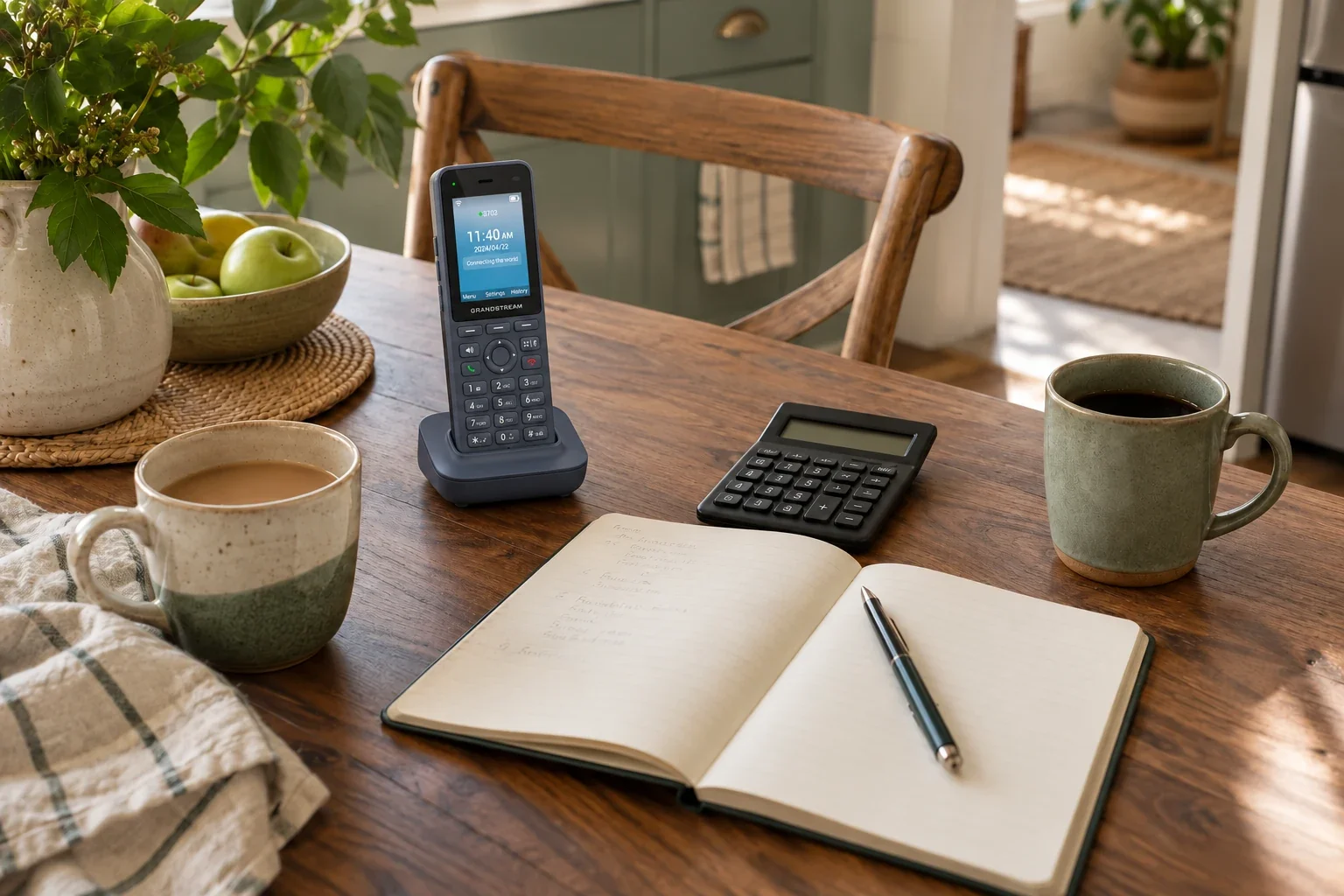
A phone’s price has several parts. There is the equipment you buy, the service you keep, and sometimes the calls you make. The right comparison starts with the people your household actually wants to reach.
Our comparison tool lets you choose another provider, your calling mix, and a Doorman account plan. Here are three ways to think about those choices.
Start with the equipment
Our provisional ready-to-use Doorman bundle is $190 for a Brain, Ethernet cable, power cable, one WP826 handset, and shipping. This is a planning price, not an orderable offer or a tax-inclusive quote. More rooms need more handsets; their cost is additional.
If you already have a supported computer or compatible SIP handsets, your hardware budget may be lower. Check compatibility before counting equipment you own as usable. Electricity, your existing internet service, and eventual replacement equipment also belong in your household budget.
Household one: a few calls most days
Suppose you talk for 300 minutes a month, all to regular outside numbers, with 70% outgoing and 30% incoming. Using the comparison tool’s US Telnyx example—$1/month for a number, a $1.50/month emergency-service planning allowance, $0.005 per outgoing minute, and $0.0032 per incoming minute—the listed recurring cost is about $3.84/month with a Free Doorman account.
That is approximately $236.06 for the first year, including the provisional $190 bundle. It excludes taxes, other provider fees, international or special destinations, extra handsets, internet, and electricity. The emergency-service charge must be confirmed in the provider’s portal; the allowance is an assumption in this example, not a verified quote for your account.
Here is that household’s complete planning breakdown in USD:
| Charge | Basis | Amount |
|---|---|---|
| Brain, cables, one WP826 handset and shipping | Provisional kit, once | $190.00 |
| One US phone number | Each month | $1.00 |
| Emergency service | Monthly planning allowance; confirm your account | $1.50 |
| Outgoing calls | 210 minutes × $0.005 | $1.05 |
| Incoming calls | 90 minutes × $0.0032 | $0.29 |
| Free Doorman account | No paid subscription | $0.00 |
| Listed recurring charges | Per month | $3.84 |
| Year one | Kit + twelve months of calling | $236.06 |
| Later year, same usage and equipment | Twelve months of calling | $46.06 |
Totals use the unrounded minute rates. Rounding the monthly display before multiplying by twelve would produce a slightly different annual figure. This household buys no extra handsets, paid content or relay-minute packs. Extra equipment, number porting, taxes, other provider fees, internet, electricity, maintenance and replacement costs are not assumed free: they are excluded and need their own budget.
With the same hardware and calling pattern, adding the planned Basic account at $12/year makes year one $248.06; Plus at $24/year makes it $260.06. These optional hosted services do not buy phone service, and paid plans are not available to purchase yet.
The pricing-page breakdown and calculator use this same Free-account, 300-minute, 70/30 starting scenario. Change the calculator’s controls for your own household. The hardware page brings the kit, home requirements, setup expectations and availability together.
The Telnyx number pricing and SIP rate card explain the listed charges and rate differences. Check the actual destinations and billing terms before choosing a service.
Household two: everybody talks for hours
At 3,000 outside minutes a month with the same 70/30 split, those assumptions give about $15.88/month, or $380.56 in the first year with the provisional bundle, before the exclusions above.
A flat-rate option can become more attractive as calling increases. Ooma lists Basic at $0/month plus applicable taxes and fees, and Premier at $9.99/month plus taxes and fees. Equipment is additional. For covered domestic calls, its recurring cost may beat this high-usage Doorman example; your location’s fees and the equipment you need determine the complete comparison.
Basic and Premier have different included features. Compare the things you value—such as call-screening controls—alongside the price, without pretending every plan does the same job.
Household three: everyone already has a Tin Can
If the people your child calls already use Tin Can, its Can2Can plan has no subscription charge. Tin Can’s plan explanation distinguishes those calls from calls to ordinary outside numbers. A phone is listed at $100 before applicable discounts and other charges.
That can be a compelling fit. Count any new phones relatives would have to buy, or consider the Party Line service if they want to keep their existing numbers and handsets. Shared and separate lines have different subscription implications; check the current plan terms.
Doorman’s local room calls and household-managed private-network calls are also distinct from paid outside calling. They should not be counted as Telnyx minutes. The comparison tool separates these choices instead of assuming every call follows the same route.
Keep the account plan separate
Free is $0/year. Basic is planned at $12/year, and Plus at $24/year. These upcoming subscriptions add hosted services; they do not replace your outside calling provider. Content purchases and any applicable Doorman Network minute packs are separate too.
Free calls and relay minutes are different budgets
Room2Room calls and calls over a private network the households manage have no Doorman calling charge. Your equipment and network still have costs.
The planned Doorman Network separates direct calls, which use no relay minutes, from calls our relay carries. Every account is planned to receive 500 relay minutes per year, shared across its houses, resetting on its anniversary. In a two-person relayed call, the caller pays the minutes. An optional $10 Family pack adds 5,000 minutes and lasts 24 months. It is not required in the all-outside-calling example above. This is the planned service model, not an assertion that the hosted calling network is available today.
If a call goes through your ordinary phone provider instead, its rates apply. “Free Doorman account,” “free Room2Room calls,” and “included relay minutes” therefore mean different things; none promises unlimited free calls to ordinary numbers.
Worked example updated October 28, 2026. Telnyx’s published number, SIP and emergency-service pricing was rechecked on that date and matches the saved rate assumptions. Competitor reference prices retain their October 15, 2026 snapshot. Confirm your provider account’s actual emergency-service charge, rates and fees before relying on the estimate. Try your own household in the comparison tool, then confirm the provider’s actual quote. Sometimes another phone is the less expensive choice. Doorman should earn its place through the combination of price, flexibility, and the things your family wants to do with it.